This issue: 119 new papers / 119 independent works · Tracks: VLN 14 / embodied agentic navigation 5 · Other directions 100 · R2R-CE 2 · WeChat 0 · 6 existing papers updated
1. Key points
- Continuous-navigation performance and instruction fidelity are being tested separately. SimpleVLN reports continuous-benchmark results; NavBind fixes the scene and history while changing fork instructions to test whether actions change with language. The two R2R-CE works provide different kinds of evidence.
- Finding a candidate object still requires verification. CLOSER turns verification before stopping into evidence collection across views. Goal recognition, distance estimation, and termination are studied separately rather than all being treated as exploration failures.
- Reachability and physical passability impose different conditions. PASS-VLN varies robot width to test reaching versus stopping; VeSTA optimizes candidate trajectories with strict-contact feedback. They address embodiment constraints and collision execution, respectively.
- Remembering dialogue does not guarantee locating its referent. In DialogMem, appending dialogue to visual memory substantially improves question answering but barely improves navigation. Object linking, correct retrieval, and location recovery remain separate bottlenecks.
2. Deep reads
1. SimpleVLN: preserve the native architecture and jointly improve memory, data, and training
Paper · Track: VLN · My reading guide (Chinese) · Instruction following · R2R-CE / RxR-CE (continuous environments)
Problem. Has the navigation potential of native multimodal models been exhausted before adding specialized modules?
Method. Fixed-budget global-local memory and action chunks accompany expert demonstrations, policy-dependent DAgger data, and synthesized tasks in progressive IL→DAgger→RL training.
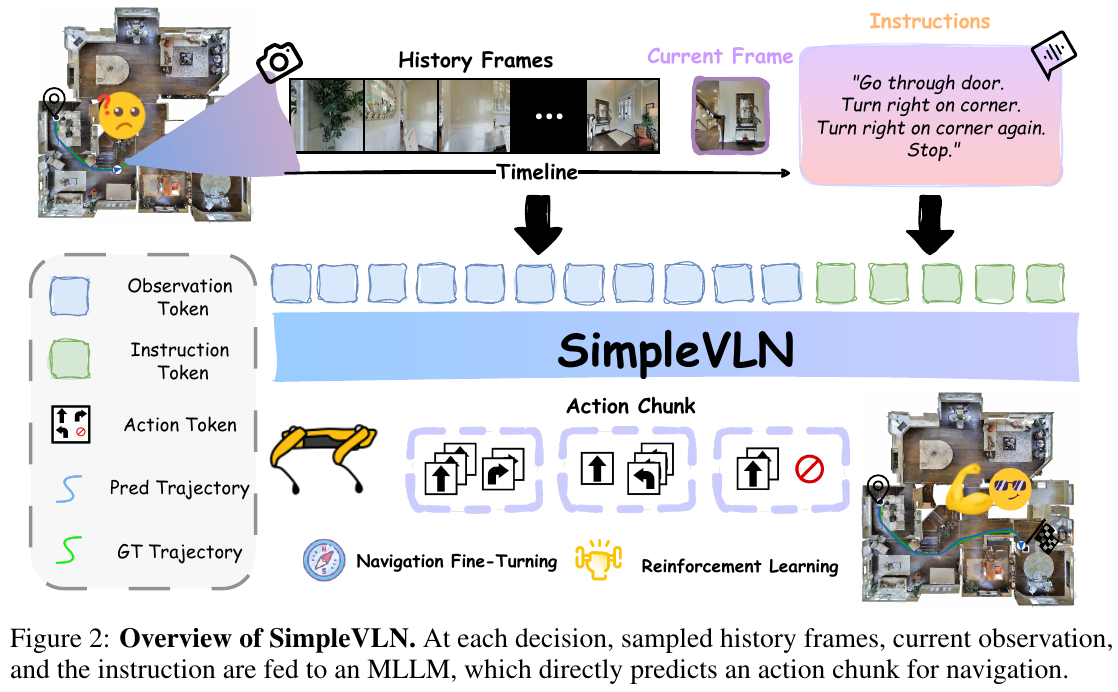
Evidence. The abstract reports R2R-CE SR of 76.7% and RxR-CE SR of 80.1%, without naming the specific splits.
Assessment. This is a useful ground-VLN baseline for testing architectural additions. Data and training change together, so ablations, data budgets, and contact settings need checking; the abstract gives no real-robot metrics.
Next step. Read closely: confirm evaluation splits, then separate memory, DAgger, and RL gains.
2. CLOSER: turn stopping into active evidence acquisition
Paper · Track: VLN · ObjectNav · Gibson / Habitat-Matterport 3D
Problem. Confident single-frame detections can confuse similar objects and cause false stops.
Method. A fine-tuned VLM assigns target, non-target, or uncertain labels to views of tracked candidates. Diversity gating and probability fusion combine evidence; a diffusion policy approaches for further observation when uncertainty persists.
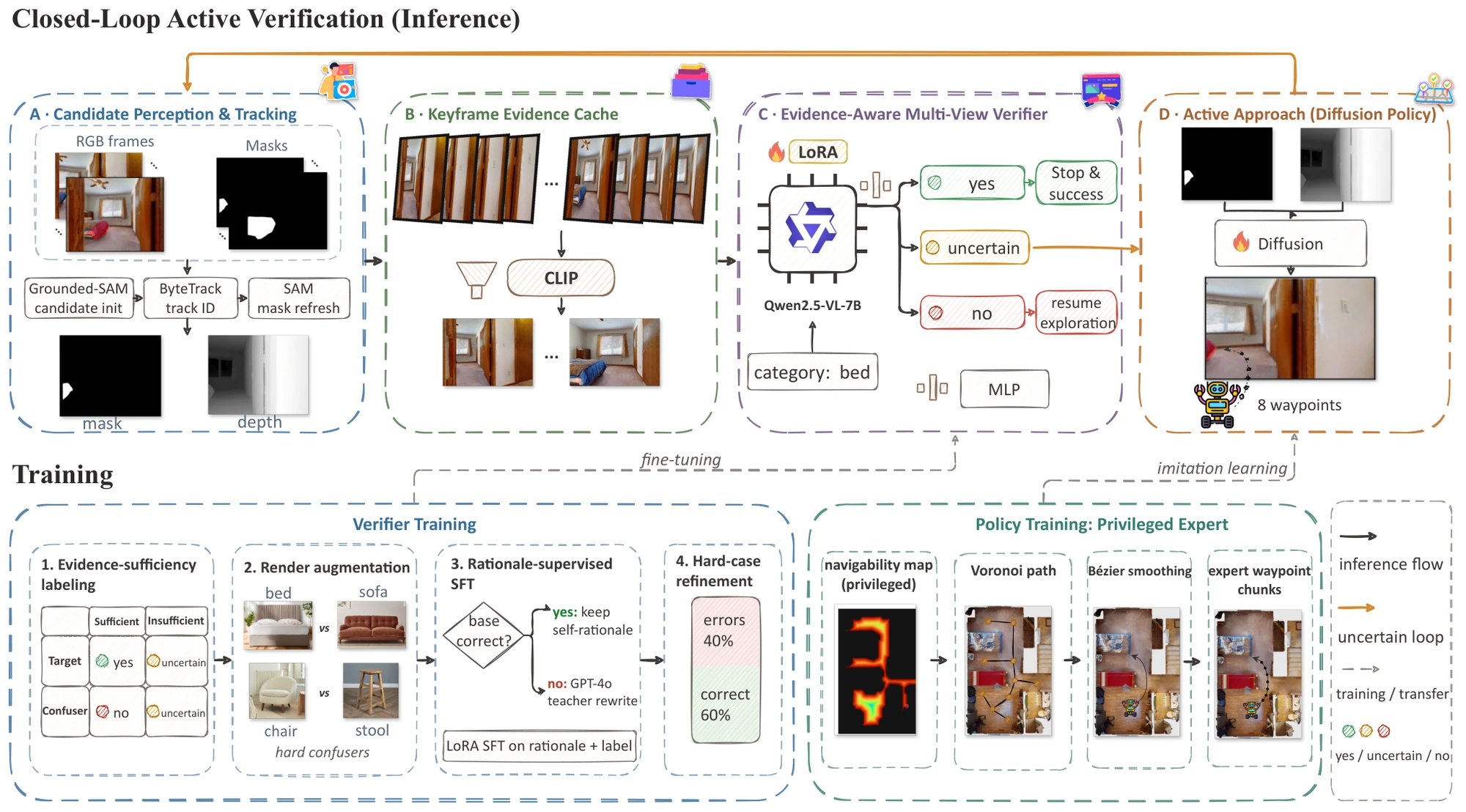
Evidence. The abstract reports mean SR gains of 3.6 points and SPL gains of 2.0 points across the two scene collections.
Assessment. This could supply stop verification for existing ObjectNav systems. The navigator needs no retraining, but the verifier VLM requires fine-tuning. The abstract gives no real-robot results; extra travel, latency, and false rejection need checking.
Next step. Reproduce: compare single-view stopping, passive multi-view fusion, and active verification on false stops and SPL.
3. PASS-VLN: the same instruction should yield different outcomes as robot width changes
Paper · Track: VLN · Local language navigation · PASS-VLN
Problem. Assuming instructions are executable conceals local passage failures caused by body size.
Method. Scene, instruction, start, and reference route remain fixed while body width varies. Obstacle inflation in a depth-derived local BEV encodes width, fused with visual-language context to predict latent action codes for continuous closed-loop execution.
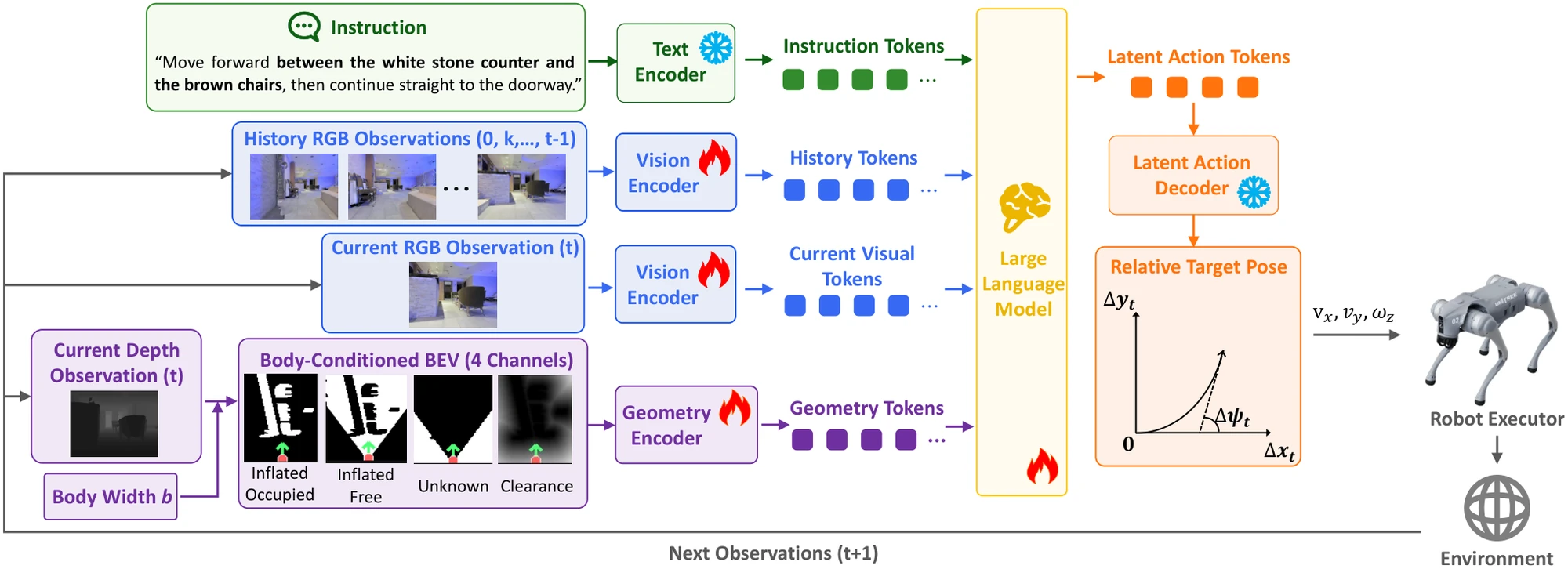
Evidence. The abstract reports approximately 12 percentage points higher collision-free success on PASS-VLN than a strong VLN model fine-tuned on the same benchmark, plus unseen-width generalization and real-robot deployment.
Assessment. The benchmark separates route misunderstanding from physical blockage. Local commands do not replace long-horizon R2R-CE; no real-robot success rate is given.
Next step. Read closely: check stopping criteria for blocked passages and width boundaries under depth error.
4. VeSTA: align training feedback with strict-contact execution
Paper · Track: VLN · Continuous VLN · Abstract names R2R / RxR without an explicit CE designation
Problem. Permissive collision models may let physically infeasible actions complete navigation.
Method. Trajectory Relative Group Policy Optimization uses strict-contact feedback to increase executable candidates. A traversability risk critic then selects candidate futures by risk-adjusted utility.
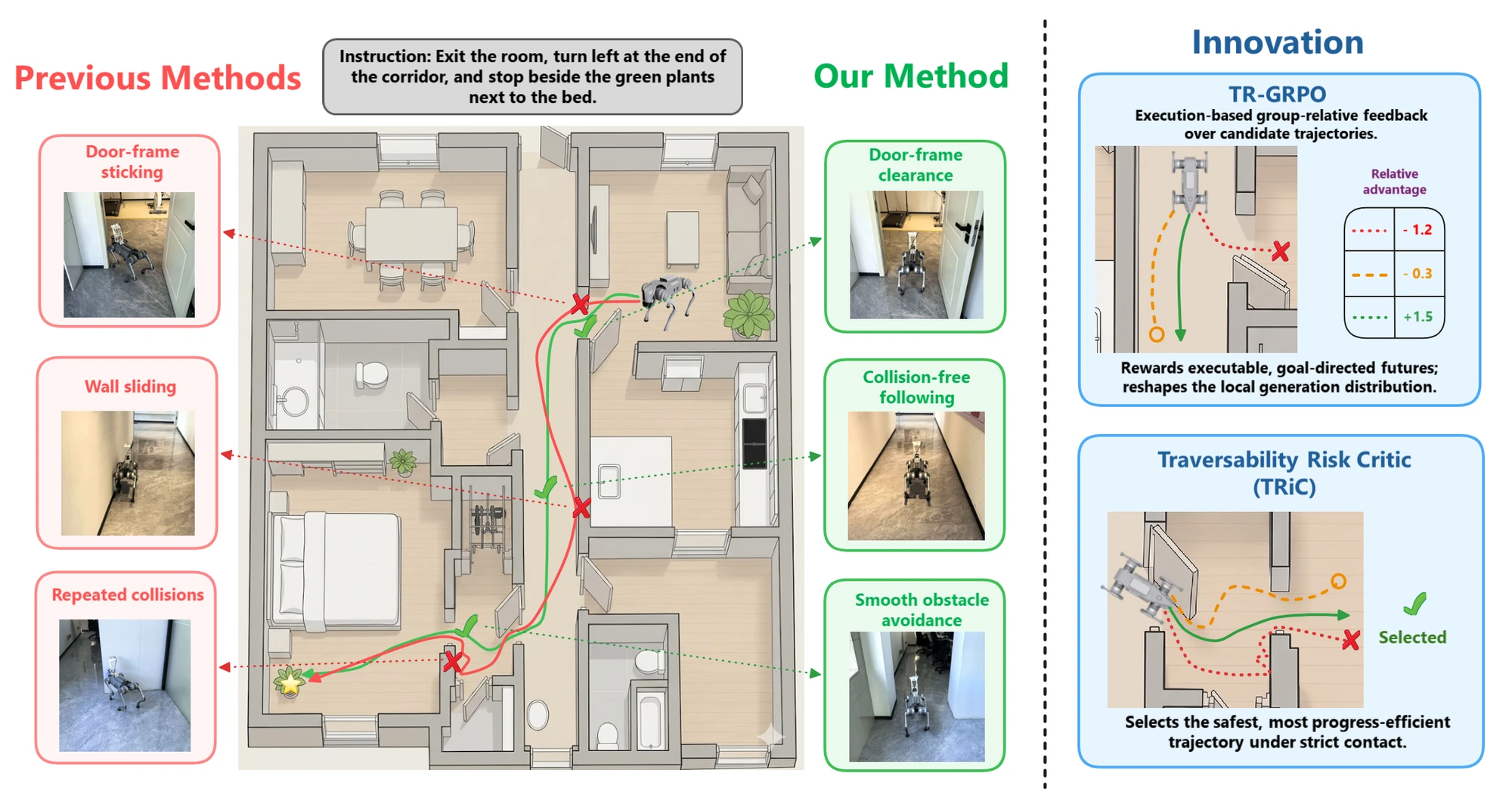
Evidence. No numerical results in the abstract; the paper reports fewer collision failures under strict contact and controlled real-robot transfer experiments.
Assessment. Candidate-distribution improvement and candidate selection need separate attribution. The task uses continuous execution, but the abstract’s R2R / RxR names do not establish the CE versions. Results should neither be treated as discrete-benchmark scores nor entered directly into CE rankings.
Next step. Read closely: confirm task versions, collision implementation, and hardware sample sizes before comparing SR and collisions.
5. DialogMem: dialogue memory must link to objects that can be located
Paper · Track: embodied agentic navigation · Dialogue memory · Instance-level object navigation / question answering
Problem. Visual memory struggles to persistently link human dialogue to specific previously observed objects.
Method. Memory is formed from aligned posed RGB-D and dialogue streams, then retrieved for navigation and question answering, with unified comparisons of formation, retrieval, and output reasoning.
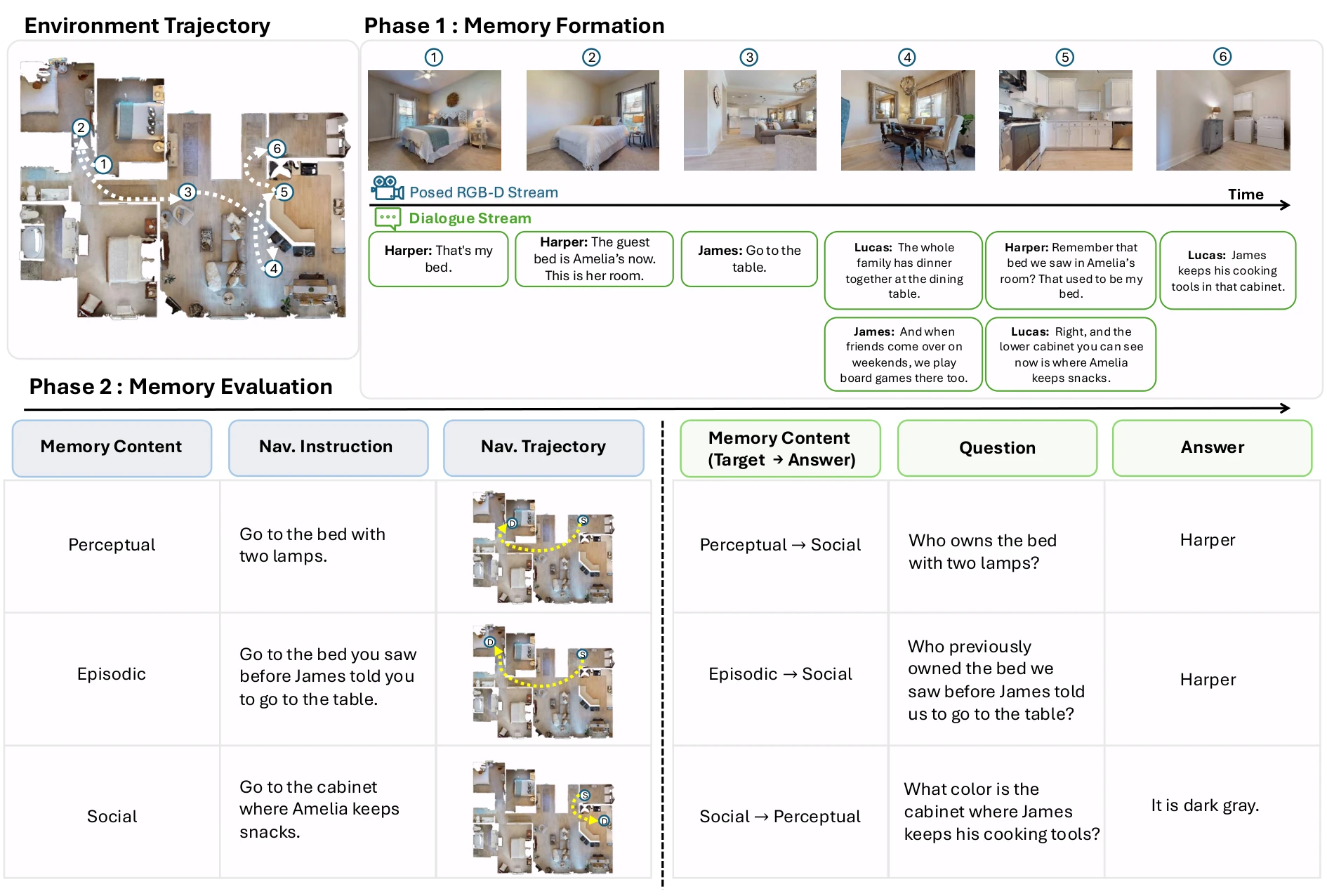
Evidence. The benchmark contains 142 episodes in 27 real-world scenes, 14,193 QA pairs, and 11,890 navigation instructions. The abstract gives no navigation SR and reports negligible navigation gains from appending dialogue.
Assessment. Remembering relevant speech and retrieving the right object and location require separate validation. Real-scene data do not establish closed-loop robot deployment; QA gains do not establish navigation gains.
Next step. Read closely: inspect linking, retrieval, and localization diagnostics for error accumulation across stages.
3. Also worth a look
- NavBind · R2R-CE / RxR-CE: 3,252 fork contexts test instruction–action binding with fixed history.
- StopWatch · ObjectNav: explicit goal grounding and distance estimation, with corrected annotations; no numerical results in the abstract.
- ReInsVLN · Memory use: compresses history and schedules reminders; the abstract says R2R without specifying continuous or discrete execution.
- HAVANA · Two-rate planning: slow latent plans and fast local trajectories, without future-video generation at inference.
- CovNav · ObjectNav: calibrated uncertainty determines when to invoke slow reasoning.
- ChairNav · Physical wheelchair: cross-embodiment pretraining, domain adaptation, and post-training from user interventions.
- EchoNav · Visual navigation: historical fusion and confident occupancy completion distinguish observed free space.
- Sparse Topometric Graph · Cross-session navigation: local geometry and connectivity support map matching.
- InstAgent · Collaboration: behavior trees encode assignment and handoff checks, retaining programs revised through feedback.
- Refinable Semantic Mapping · Dynamic memory: pointwise confidence updates remove noise and obsolete object points.
4. Trends and actions
Trends
- Navigation evaluation is separating arrival, instruction following, and executability. SimpleVLN, NavBind, and VeSTA provide evidence on performance, language dependence, and physical execution. These dimensions should be reported together; one SR cannot substitute for them.
- Stopping and handoffs are becoming independent feedback loops. CLOSER, StopWatch, and InstAgent make goal confirmation or stage-completion evidence explicit. Useful comparisons include false stops, missed stops, and execution overhead.
- Memory increasingly concerns invalidation and localization, beyond retaining more history. DialogMem, Refinable Semantic Mapping, and EchoNav support separate evaluation of object linking, evidence updating, and spatial recovery.
Research gaps
- A unified ground-VLN evaluation combining instruction counterfactuals, body width, strict collisions, and stop verification is missing. Whether isolated module gains compose over long horizons remains unverified.
- This issue provides insufficient evidence that dialogue-object memory supports real-robot localization and safe stopping after objects move.
Next steps
- High · Read closely SimpleVLN: confirm continuous-benchmark splits, data, and training costs to establish a comparable baseline.
- High · Reproduce NavBind: swap instructions in paired fixed fork states, measuring both action changes and directional correctness.
- High · Reproduce CLOSER: retain the navigator and test verification effects on false stops, success, and path cost.
- Medium · Read closely PASS-VLN / VeSTA: identify implementation differences between embodiment constraints and strict contact, then design ablations.
- Medium · Track DialogMem: follow object-linking and localization interfaces, prioritizing moving-object conditions.
5. Complete work index
A denotes direct relevance, B a transferable mechanism, and C field observation; the five groups below cover all 119 independent works in this issue.
VLN and semantic navigation · A · 14 works
- ChairNav: Wheelchair adaptation across embodiments and from user interventions.
- HAVANA: Asynchronous latent plans and fast local trajectories.
- PASS-VLN: see deep read.
- SimpleVLN: see deep read.
- StopWatch: Explicit goal grounding and stopping.
- EmbodiedWorld-200K: Navigation-planning data and interaction training in world models.
- ReInsVLN: Compressing and revisiting historical evidence.
- VeSTA: see deep read.
- CLOSER: see deep read.
- CovNav: Selecting slow reasoning with calibrated uncertainty.
- EchoNav: Evidential occupancy completion from historical observations.
- Navigation Explainability: Explaining assistive navigation with obstacles and future trajectories.
- NavBind: Testing language–action dependence at fixed route forks.
- FETA: Adapting through binary feedback on selected critical actions.
Embodied agentic navigation · A · 5 works
- InstAgent: Behavior trees, shared memory, and collaborative handoffs.
- DialogMem: see deep read.
- Structure over Reasoning: A small model supplies perceptual evidence to structured navigation modules.
- DPGP: Discovery-probability graphs for hidden cooperation needs.
- TARSphere: Long-horizon tasks under evolving physical and social constraints.
Transferable mechanisms and VLA / manipulation · B/C · 76 works
- Cambrian-BEV: Spatial token aggregation compresses multi-frame histories.
- FOUND-IT System: Integrating monocular scene graphs into mobile manipulation.
- Robot Metareasoning: State-dependent computation and action-commitment budgets.
- Offline Empowerment: Estimating exploration value from offline trajectories.
- GOFusion: Fusing occupancy and Gaussian submaps for active observation.
- LateMatch: Caching intra-image context and deferring cross-image matching.
- RCRA: Adapting conservative navigation to pedestrian reactivity.
- BetaMem: Traceable memory writing, forgetting, and local rule repair.
- CoopUQ: Cooperative occupancy forecasting and uncertainty-aware navigation.
- ForagerSim: Evaluating map-based reasoning in large dynamic worlds.
- LVMem: Linking retrieved text back to original visual evidence.
- MEAN: A networking survey organized around closed-loop embodied tasks.
- CAPSafe: Separating contextual action safety from long-horizon planning.
- Industrial COMPASS: Industrial navigation transfer with digital twins and synthetic augmentation.
- Externalise the Memory: Comparing external retrieval and distillation under fixed policies.
- VLA Corpus Selection: Testing whether counterfactual diagnostics improve corpus selection.
- PAPAV: Reviewing evaluation across perception, anticipation, planning, action, and verification.
- Sparse Topometric Graph: Matching maps across sessions through geometry and connectivity.
- CARE: Critic-guided cloud escalation with shared handoff memory.
- Refinable Semantic Mapping: Pointwise confidence updates remove obsolete spatial memory.
- Data, representations, and training (17): GRASP, ActiveAlign, Model-to-Policy, GazeAct, Relational Spatial Alignment, ALIGN, FR-VLA, Agricultural VLA, VLDA, PLaCA, Real2Sem2Real, Generative Plan Latents, AtomicRL, SimPT, DRILL, Sensorimotor Alignment, Tactile Manipulation Survey
- Memory, monitoring, and execution frameworks (14): RePlanMem-VLA, IMEP, VLA Memory Survey, RTPC, Runtime Safety Check, EventSync, FIT-MAC, JARVIS, RoboCasa-Shift, SERA, PAL, Echo, WholeBodyMem, Progress Probes P2
- Inference, compression, and continual adaptation (12): MambaAct, NestedVLA, FlashRT-PAI, SARAM, VLA-Rolling, PaceVLA, SPAR, PACT-VLA, Kernel-Variance Heads, FocusVLA, SmolVLA-MoE, One-Step Flow Policies
- Whole-body and multi-arm coordination (5): CoEvolve, VLA-Fabric, HAF-VLA, Ropedia W0, SP-HLM
- Manipulation capability and robustness benchmarks (4): LIBERO-Pro2.0, BiDex-100, HandsOn, VLA-Retain
- Visual task redirection (1): TRACO
- Manipulation diagnosis and applications (3): RoboPhoto-VLA, Failure Attribution, FlowVLA
Flight, driving, control, and medical robotics · C · 15 works
- Flight and underwater robotics (4): AeroDASH, AQUAACT, MCTS UAV Planning, KinoUAV
- Autonomous driving (4): Scene-Adaptive VLA, LECDrive, Perception–Action Binding, Reasoning–Action Coupling
- Localization, geometric traversal, and control (5): IMU-Aided VLP, Adaptive Traversal Tubes, Integrating Flow Matching and Model P…, SAFTER, Balance–Navigation Coordination
- Endoscopic navigation (2): EndoVLA-OOV, EBV-CAN
Virtual worlds, vision, and other work · C · 9 works
- Virtual worlds and game agents (4): Mirror, KPHarness, Scaling in Games, HiSTEVE 1.0
- Segmentation, video physics, and hand reconstruction (3): UGA, PVBench, DewHand
- Navigation-video generation (1): Map2Vid
- Mobile GUI (1): TAG-Nav