This issue: 102 new papers / 102 independent works · Tracks: VLN 9 / embodied agentic navigation 9 · Other directions 84 · WeChat 0 · 1 existing paper updated
1. Key points
- Memory maintenance now covers retention, clearing, and reflection. Spatiotemporal Memory organizes historical evidence, MOON addresses post-deviation inertia, and RetroNav links failure explanations to scene records.
- The planning–execution interface becomes a training objective. MATCH jointly optimizes waypoint requests and primitive-action execution. This batch’s semantic-safety evaluation also tests risk recognition separately from motion adaptation.
- Help-seeking enters lifelong navigation harnesses. EvoLife connects interaction, action tools, and place memory. Its results depend on guidance conditions; first visits, revisits, and continuous tasks require separate reading.
2. Deep reads
1. MOON
Recovery requires deciding when to clear history.
Paper · Track: VLN · Instruction following · R2R-CE / RxR-CE (continuous environments)
Problem. History supports route following but can perpetuate action inertia after a deviation.
Method. A deviation judge triggers history clearing and hands control to a GRPO-trained recovery policy. The frozen base receives less than 1% additional parameters.
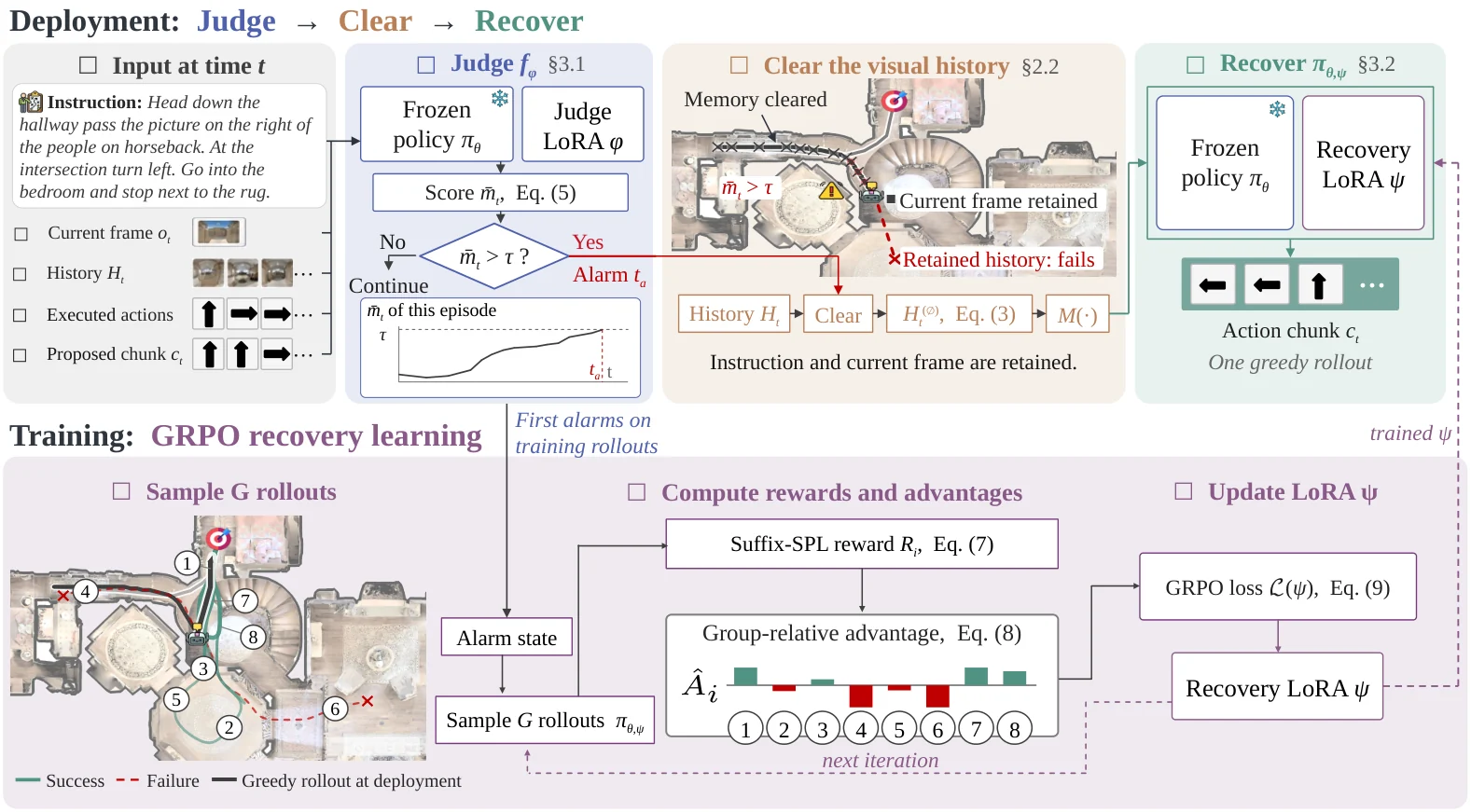
Evidence. The abstract reports SR gains of 5.2 and 6.0 percentage points over the frozen base on R2R-CE and RxR-CE. A random-trigger ablation supports the importance of timing.
Assessment. This separates memory errors from action errors. Clearing can harm on-route episodes, so false alarms must be measured alongside recovery. The abstract gives no physical-robot results.
Next. Reproduce: compare retained history, periodic clearing, judge-triggered clearing, and recovery from identical deviation states.
2. MATCH
Planning targets should adapt with executor capability.
Paper · Track: VLN · Hierarchical planning and execution · R2R-CE / RxR-CE (continuous environments)
Problem. A learned planner paired with a fixed executor can repeatedly request unreachable waypoints.
Method. An execution-aware graph combines value estimates and outcome memory with continuous target refinement. Rewards balance ordered route progress and execution residual; both policies update together.
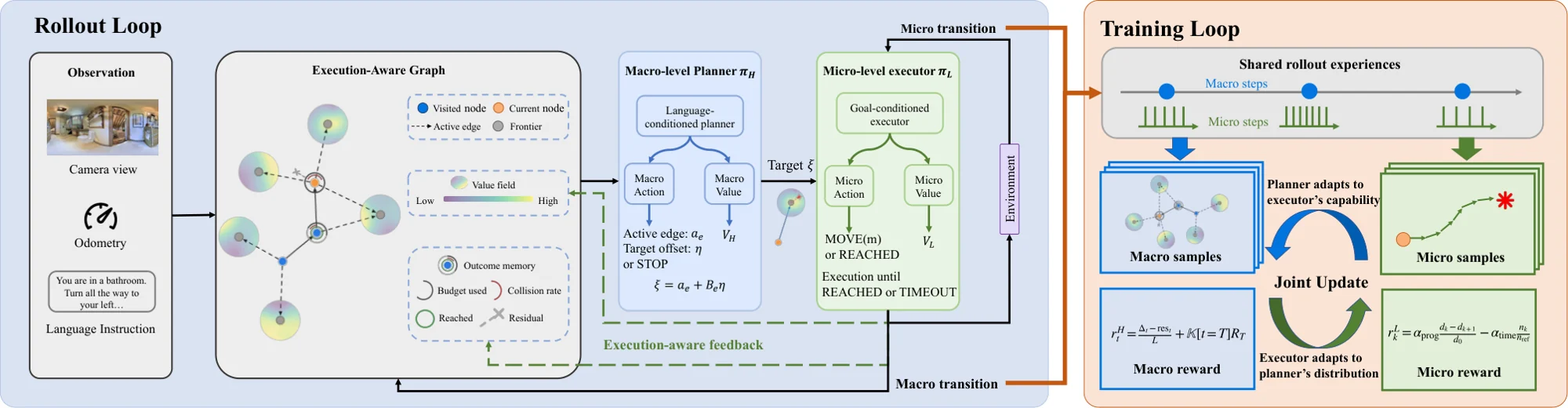
Evidence. The abstract gives no numerical task scores, claiming leading R2R-CE / RxR-CE results with 0.5B parameters. The paper shows only 4 physical-robot episodes.
Assessment. This targets executability while retaining instruction constraints. 4 hardware episodes cannot establish deployment reliability; local arrival is also insufficient evidence of full instruction completion.
Next. Read closely: check collision settings and isolate target offsets, joint training, and route rewards.
3. EvoLife
Connect help-seeking and place memory to the navigation loop.
Paper · Track: embodied agentic navigation · Interactive navigation / ObjectNav / continuous multi-task navigation
Problem. Separating movement, clarification, and memory makes interaction-derived knowledge hard to reuse.
Method. A unified harness exposes waypoint, discrete, pixel, and object navigation tools. Dialogue and observations attach to places for later retrieval and revision.
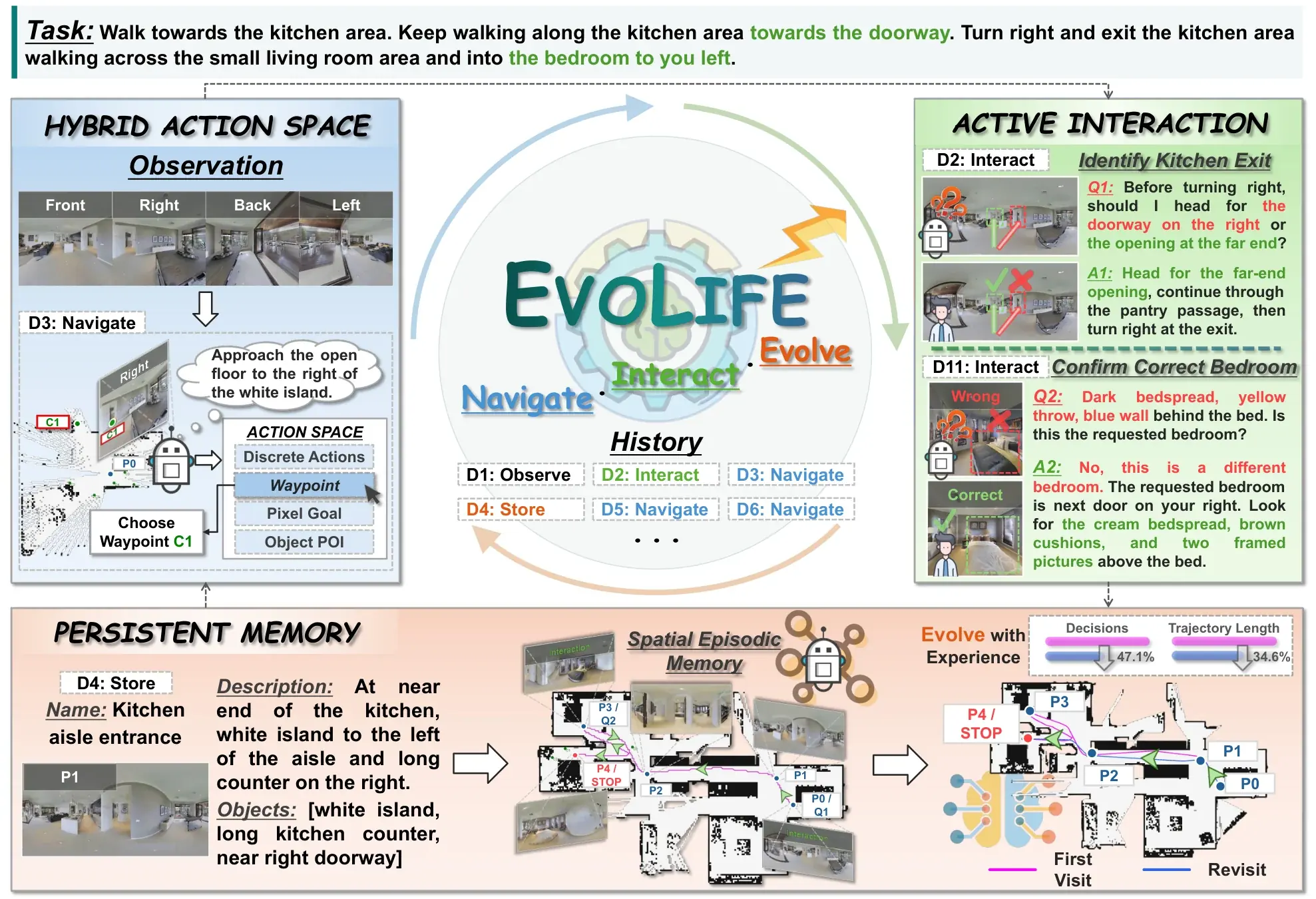
Evidence. The abstract reports 100% first-visit SR across four 100-episode VLN / ObjectNav sets, averaging 1.87 interactions per episode. Complete-sequence SR is 98% and 94% on LHPR-VLN and GOAT-Bench, respectively (50 sequences each).
Assessment. These are assisted-system results. The simulation guide accesses privileged routes and goals, precluding equivalence with unassisted VLN. Real help-seeking costs and incorrect answers need evaluation.
Next. Read closely: hold the navigator and interaction budget fixed while comparing absent, restricted, and full guidance.
4. RetroNav
Failure reflection needs verifiable scene evidence.
Paper · Track: embodied agentic navigation · Lifelong navigation / repeated attempts
Problem. Scene knowledge alone does not explain failed decisions or identify what a retry should change.
Method. Unified memory links geometry, semantics, and navigation experience while separating observations from task interpretations. An independent evaluator requests retries; a retrospection agent produces an evidence-grounded brief.
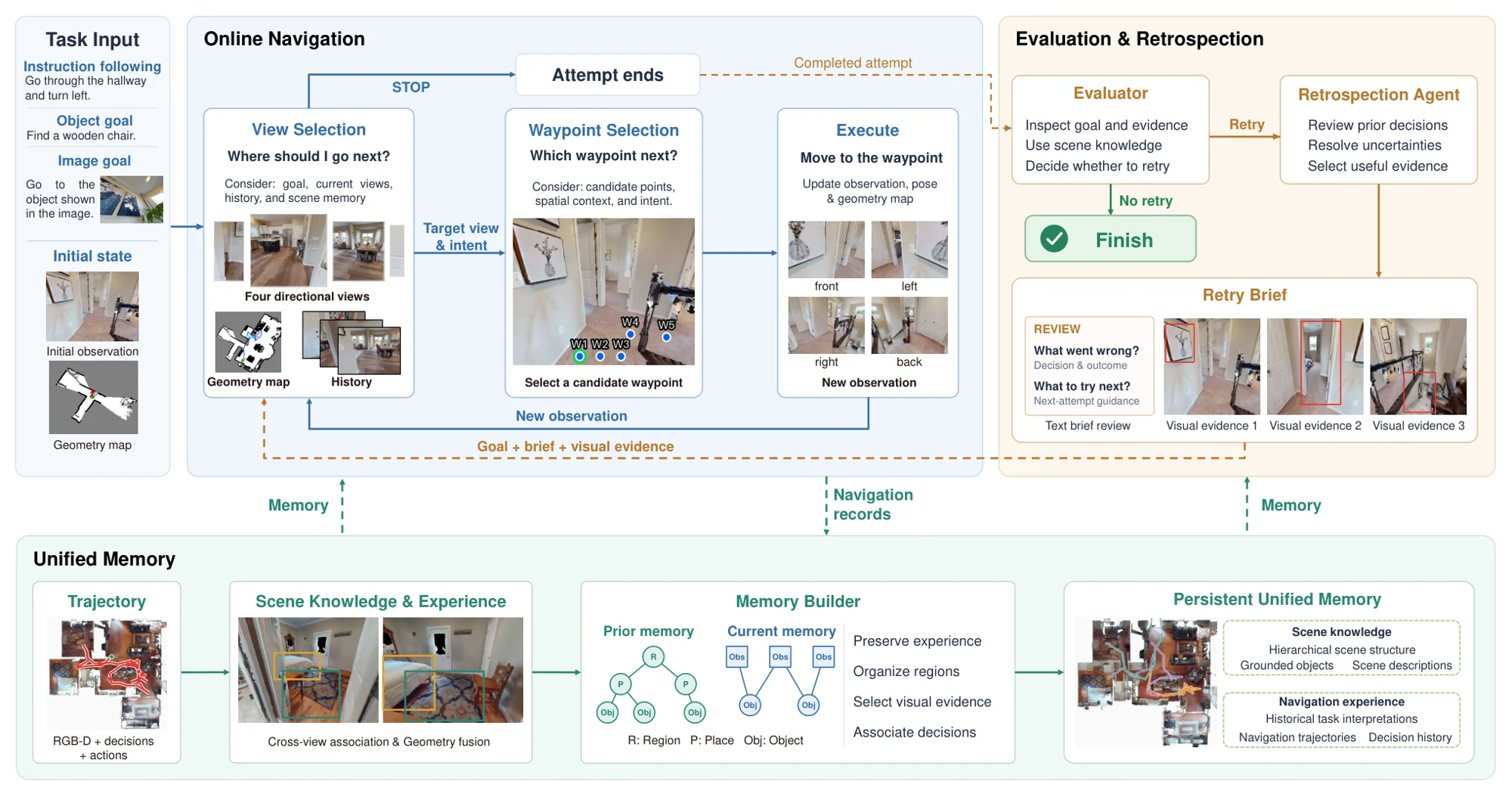
Evidence. The abstract gives no numerical results, claiming leading performance on five navigation benchmarks.
Assessment. This can test whether reflection cites genuine evidence. Repeated attempts add information and budget, so first-attempt success, retry recovery, cumulative path length, and model-call costs should all be reported.
Next. Reproduce: compare naive retries, scene-memory-only retries, and evidence-grounded briefs with the same retry budget.
5. Spatiotemporal Memory
Memory must support progress, historical evidence, and geometry.
Paper · Track: embodied agentic navigation · Zero-shot VLN · R2R-CE val-unseen (continuous environments)
Problem. Retaining history does not ensure accessible evidence; current views alone invite repeated exploration.
Method. Task memory tracks progress, temporal memory compresses pose-anchored observations, and spatial memory accumulates geometry. An 8B observer and an 8B reasoner select waypoints or extra views; geometric control executes them.
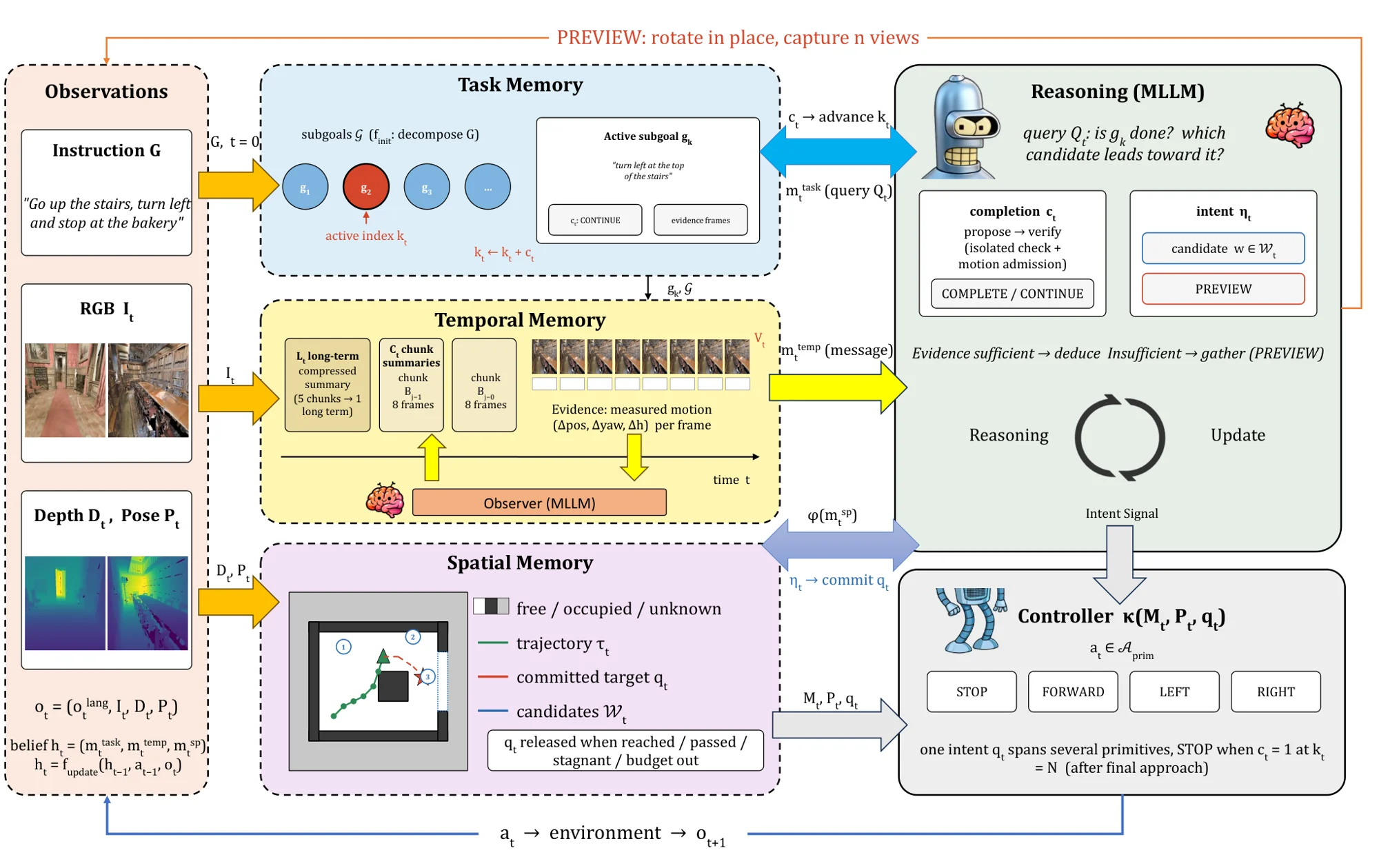
Evidence. The abstract reports that removing temporal memory increases average path length from 16.9 m to 39.1 m on R2R-CE val-unseen, without numerical SR.
Assessment. Path efficiency merits attention, but this is more than one “8B model.” Hardware evaluation uses a remote A100 and localization in a prebuilt map, leaving fully onboard operation without prior maps unestablished.
Next. Read closely: align localization and action interfaces, then compare paths, SR, tokens, and extra-view costs.
3. Also worth reading
- RepresentNav · VLN: self-constructed visual features and latent prediction; the abstract reports 83.80% SR on VLNVerse fine-grained.
- One Scan is Enough · VLN: one scan builds training environments; the abstract reports 85% SR across five real environments and 82% in unscanned areas of the same buildings.
- MEMVLN · VLN: bounded episodic memory and route reconstruction; hardware testing holds out only six instructions, requiring scrutiny of repeated-trial protocols.
- ASPEN · VLN: event-triggered semantic reasoning; on RxR-CE val-unseen, VLA calls fall 9.5% and estimated inference time falls 8.1%.
- Natural-Language to Nav2 · Agentic navigation: language compiles to JSON policies, passes deterministic checks, and projects into Nav2 costmaps.
- PIFR · Agentic navigation: PIFR separates inserted-task completion, original-task resumption, and full-sequence completion.
- HGWM · Agentic navigation: room–object priors and persistent graph memory support graph matching; HM3D v0.1 SR 62.6%, SPL 31.5%.
- ThinkLocoManip · Agentic navigation: a legged loco-manipulation harness orchestrates navigation, locomotion, and manipulation, retaining recovery context through keyframes.
- VISTA · Transferable mechanism: actively generated rollouts validate harness edits; this could inform retesting after navigation reflection.
- LOGIV · Transferable mechanism: continuous dependency checks and local repair could maintain navigation subgoal preconditions.
4. Trends and actions
Trends
- Memory gains depend on timing and evidence organization. MOON, RetroNav, and Spatiotemporal Memory address clearing, reflection, and retrieval. They warrant comparison under shared budgets rather than by cache length alone.
- Harnesses need separate accounting for execution, assistance, and recovery. MATCH constrains execution requests, EvoLife introduces external guidance, and PIFR handles runtime interruption. Final arrival rates cannot explain each component’s contribution.
Research gaps
- Navigation recovery lacks evaluations jointly fixing action interfaces, history budgets, model calls, and retry counts. Stronger policies remain difficult to distinguish from additional opportunities.
- Privileged guidance, remote inference, and prebuilt-map localization differ from ordinary ground-robot conditions. Removing them individually would establish practical capability boundaries.
Next steps
- High · Reproduce MOON: build matched-state deviation interventions and record false alarms, recovery SR, and cumulative path length.
- High · Read closely EvoLife: list guide-visible information and compare absent versus restricted guidance before assessing transfer.
- Medium · Compare MATCH: fix executors and contact settings, then compare target adjustment, executor training, and joint training.
- Medium · Prototype Natural-Language to Nav2: begin with keepouts and event-conditioned access, separately measuring parsing errors, incorrect acceptance, and execution deviations.
- Low · Track RetroNav and Spatiotemporal Memory: measure first attempts, retries, and token costs under equal budgets; defer rankings based solely on final SR.
5. Complete work index
The index covers all 102 newly added independent works; A denotes the two main tracks, B transferable mechanisms, and C broader developments. Deep-read entries link back to their cards.
VLN and semantic navigation · A · 9 works
- RepresentNav: Policy-built visual representations and future latents.
- MOON: See deep read.
- One Scan is Enough: Scene scans generate instructions and training tasks.
- Stage-Aware Attribution: Instruction-stage-aware attribution across current and historical views.
- ScheNav: Sketches and observations form exploration value fields.
- ASPEN: Command persistence schedules fresh semantic reasoning.
- OSMA-Bench: Tests clearance, speed, and smoothness by obstacle semantics.
- MEMVLN: Bounded episodic memory with masked route reconstruction.
- MATCH: See deep read.
Embodied agentic navigation · A · 9 works
- HGWM: Room–object priors and persistent graph memory guide search.
- Natural-Language to Nav2: Validated language policies project into Nav2 costmaps.
- ThinkLocoManip: Orchestrates locomotion, navigation, and manipulation with keyframe recovery.
- OmniBrain-0: Distills navigation and manipulation experts into shared decisions.
- PIFR: Separately evaluates preemption, inserted tasks, and resumption.
- RetroNav: See deep read.
- Spatiotemporal Memory: See deep read.
- EvoLife: See deep read.
- LLM-Guided Loco-Manipulation: Composes interactive navigation through skills, objects, and geometric targets.
Transferable mechanisms · B · 19 works
- ASTEROID: Student-history distillation could inform partially observed decisions.
- FP32 Master Copy: Lost low-precision updates motivate navigation fine-tuning audits.
- Horizon–Depth Coupling: Studies solver depth together with open-loop execution horizon.
- SceneBloom: Physically valid indoor layouts support ObjectNav training.
- TrajMamba: Aligns human-trajectory preprocessing between training and deployment.
- Interaction-Aware GNN: Graph-based waypoint corrections use pedestrian and goal context.
- LegoOcc++: Open-vocabulary occupancy maintains cross-view instance semantics.
- RoboDuo: Checks task completion before invoking atomic recovery skills.
- FISRF: Selects reflection and mentor guidance according to capability.
- EBench Agent Profiling: Compares direct control against harnesses invoking learned policies.
- RobotAgentBench: Evaluates autonomy through task discovery, execution, and recovery.
- The Trinity: Capability trees organize verifiable worlds and harness evolution.
- TP-JSCC: Compresses and transmits visual tokens for 3D question answering.
- VISTA: Active exploration tests edits while retaining harness lineage.
- LSMM: Position-indexed matrix memory supports legged maze exploration.
- AtomTree: Current symbolic states guide subgoal decomposition and hierarchical backtracking.
- Object Motion Anticipation: Adapts online to anticipate motion onset of novel objects.
- EmbodiExp: Composes subgoal experiences through applicability and verified outcomes.
- LOGIV: Continuously verifies task dependencies and constrains local repair.
VLA / manipulation · C · 43 works
- Demonstrations, data, skills, and simulation(16): EgoForesight, MAST-VLA, Learned Speed Prior, EXE, Speech Conditioning, Dexterous Manipulation Survey, TAD, HuGe, RynnVLA-Latent, Robot-Aligned 3DGS, Self-Labeled Preference Transfer, Tokens of Motion, BURGER, Gym-Anything for Robotics, DEED, TouchBridge
- Memory, world representations, and action generation(11): CogMemory, PDRVLA, Retrieve to Act, ThinkWorld, JAM, World Dreamer v5-lite, SaiVLA-JEPA, CoRAct, HiFOR, PRIME W0, Smooth Action Chunking
- Quantization, inference, and onboard hardware(6): AGQ, PoT-LIF, TRIAGE, JevVLA, VLA-HWBench, QbD-VLA
- Robustness, safety, and evaluation(9): VLA Failure Features, Backtrack, RobustRLlib, Federated VLA Safety, MART-GRPO, Stimulus–Response Safety, VLA-Stem, BEHAVIOR-1K Inference Settings, RoboSeed
- Mobile manipulation practice(1): Tabletop to Walking Bot
Flight, control, and other topics · C · 22 works
- Aerial and underwater robotics(6): AirPlayground, SP-Guide, Quadrotor Trajectory Control, Omni-IGN, Embodied at Sea, OpenFlyV2
- Geometry, control, localization, and driving(6): Continuous-Time Safe Planning, LECO, SG²SLAM, Geomagnetic Gradient Flow, Value-Guided MPPI, CoC-CFG
- Laboratories, general agents, and other topics(10): VERID, Whale You Go Green?, Patchwork, EMMA, Intrinsic Goals / Drosophila, Language to Drives, LongChang, Auditable Self-Driving Labs, MCP-Net, Live iOS Navigation